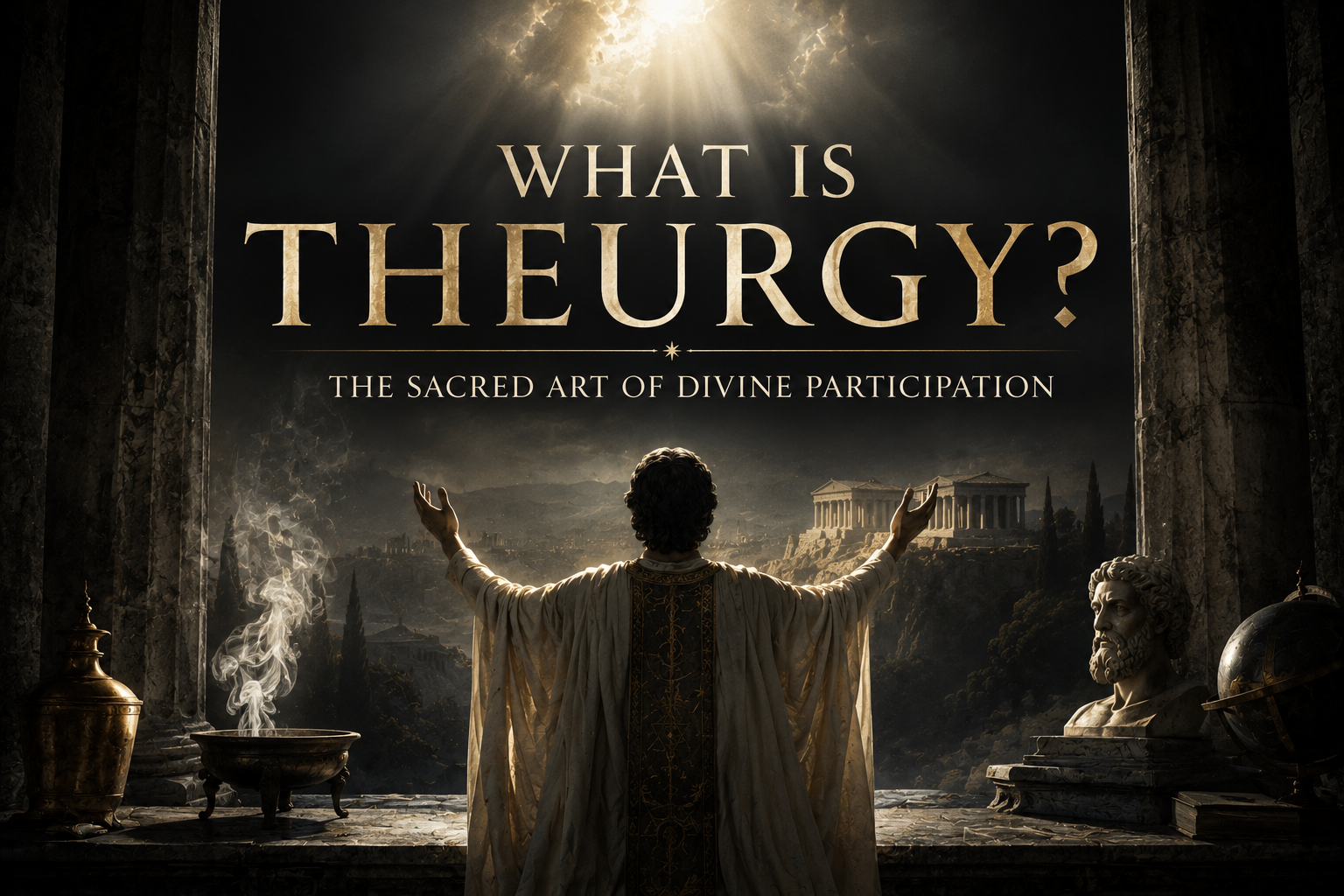
"The soul does not ascend by escaping the world, but by learning to participate rightly in the order from which the world proceeds."
Among all the words inherited from the ancient mystery traditions, few have been as misunderstood as theurgy. To some it suggests elaborate ceremonial magic, the summoning of spiritual beings, or the pursuit of occult powers. Others dismiss it as little more than a relic of late antiquity, an archaic religious practice superseded by philosophy or theology. Yet neither view captures what the great theurgists themselves believed they were doing. Properly understood, theurgy is neither superstition nor spectacle. It is one of humanity's most sophisticated attempts to answer a timeless question: How can finite human beings consciously participate in the Divine?
Theurgy is not primarily concerned with acquiring extraordinary experiences, manipulating invisible forces, or escaping the material world. Rather, it is the disciplined cultivation of a life ordered toward transcendence. It is philosophy brought into action, contemplation embodied, and worship elevated into a sacred science. The ancient theurgists understood that wisdom alone could illuminate the mind, but transformation required something more. One may intellectually understand the nature of light while remaining in darkness. Theurgy seeks not merely to describe illumination but to become illuminated.
The very word reveals its purpose. Derived from the Greek θεουργία (theourgia), it combines θεός (theos), meaning "God" or "the Divine," with ἔργον (ergon), meaning "work," "operation," or "activity." The literal translation, "the work of the gods," has often been misunderstood as implying that human beings somehow compel divine powers to act. The classical understanding is almost the opposite. Theurgy describes the work that the Divine accomplishes through a properly prepared human vessel. The emphasis is not on human control but on divine participation. The practitioner does not attempt to dominate heaven but to become receptive to it.
This distinction separates theurgy from many popular conceptions of magic. In ordinary language, magic often implies the exertion of personal will upon hidden forces to produce desired effects. Classical theurgy, particularly in the writings of Iamblichus, Proclus, and later Platonic philosophers, begins from a posture of humility rather than command. The Divine is not summoned because it was absent; rather, the soul is gradually purified so that it may recognize a Presence that has never departed. The rituals, prayers, sacred names, hymns, symbols, and contemplative practices of theurgy are therefore not instruments for controlling the Divine but disciplines that refine the practitioner into greater harmony with divine realities.
To appreciate why theurgy occupied such an important place within late antiquity, one must first understand the worldview from which it emerged. The ancient Greeks did not imagine the universe as a collection of isolated objects existing independently of one another. They saw reality as an ordered and living hierarchy in which every level of existence participated in higher principles. This participation was expressed through the Greek concept μέθεξις (methexis)—the sharing or participation of one thing in another. Beauty participates in the Beautiful. Justice participates in Justice itself. Individual minds participate in Intellect. Everything exists because it shares in realities greater than itself.
Within this vision, the cosmos is not merely a machine governed by impersonal laws but a living order permeated by intelligence. The visible world continually reflects invisible principles. Form reveals essence. Number expresses harmony. Motion discloses purpose. The universe itself becomes a sacred text in which every created thing speaks of realities beyond itself.
Theurgy is the conscious restoration of this participation. If philosophy teaches us that all things derive from higher causes, theurgy seeks to restore our living relationship with those causes. It is not content merely to explain metaphysical truths; it endeavors to embody them.
The philosopher Iamblichus, perhaps the greatest defender of theurgical practice, argued that reason alone cannot complete the ascent of the soul. Human intellect is a magnificent faculty, but it remains finite. It may contemplate divine realities without fully entering into them. Theurgy completes what philosophy begins because it engages the whole human being—body, imagination, emotion, soul, and intellect—in a unified movement toward the Divine. Sacred rituals become transformative not because they mechanically produce spiritual effects but because they reorder the entire person according to the architecture of reality.
This understanding rests upon another profoundly important insight: the human being is a microcosm. Ancient philosophers frequently described humanity as a μικρόκοσμος (mikrokosmos), a "little universe." Everything that exists within the greater cosmos finds a corresponding expression within the human constitution. We possess bodies composed of earthly elements, vital energies that sustain life, imaginations capable of forming images, rational faculties that seek truth, and an innermost orientation toward the Good itself. The human person stands at the meeting point between visible and invisible worlds.
Because of this unique position, transformation does not occur by rejecting embodiment but by harmonizing its various dimensions. Theurgy therefore concerns itself with the ordering of the entire person. The body becomes disciplined rather than neglected. The emotions become purified rather than suppressed. The imagination becomes illuminated rather than abandoned to fantasy. The intellect becomes contemplative rather than merely analytical. The will becomes aligned with wisdom rather than driven by appetite. Every aspect of the human being becomes capable of reflecting higher realities with increasing clarity.
Ancient writers often compared the soul to a temple. A temple does not create the presence of the deity; it is constructed to receive and manifest that presence. Likewise, the human soul is not made divine through ritual alone. Rather, ritual reveals and restores its capacity for divine participation. Theurgy is therefore less like building something new than uncovering what has long been hidden beneath disorder, distraction, and forgetfulness.
Symbols occupy a central place within this process. Modern culture often treats symbols as arbitrary signs whose meaning exists only because we collectively agree upon it. Classical theurgy understands symbols very differently. The Greek word σύμβολον (symbolon) originally referred to something that joined two realities together. A genuine sacred symbol does not merely remind us of a spiritual truth; it participates in that truth. Sacred geometry, planetary correspondences, divine names, hymns, ritual gestures, colors, numbers, and liturgical actions function as bridges between different levels of reality. They are languages through which invisible principles become perceptible.
This symbolic worldview extends far beyond ritual itself. The entire cosmos becomes a network of correspondences. Metals correspond with planets. Plants embody particular virtues. Musical intervals reveal mathematical harmony. Seasons mirror cycles of life and death. Light becomes an image of intellect, while fire symbolizes both purification and illumination. None of these relationships are viewed as arbitrary. They reflect an underlying unity woven into creation itself. The theurgist studies these correspondences not merely to acquire esoteric knowledge but to learn the grammar through which the universe speaks.
For this reason, purification always precedes illumination. One of the defining features of authentic theurgy is its insistence that spiritual power without moral refinement is dangerous. The Greek term κάθαρσις (katharsis) refers not only to cleansing but to the restoration of proper order. The practitioner seeks to purify intention before seeking influence, to cultivate humility before knowledge, and to establish inner harmony before attempting higher contemplative practices. Without such purification, greater energies merely amplify existing confusion. With purification, however, the soul gradually becomes transparent to divine light.
This emphasis distinguishes theurgy from every approach that seeks hidden knowledge for the sake of personal power. Genuine theurgy never asks, "How can I become more powerful?" It asks instead, "How can I become more receptive?" The highest attainment is not domination but participation.
Alchemy beautifully illustrates this principle. Although many people associate alchemy exclusively with attempts to transform base metals into gold, the deeper tradition consistently presents the laboratory as an image of the human soul. Fire, dissolution, purification, coagulation, and transmutation describe both chemical operations and interior transformation. The alchemist purifies sulfur, mercury, and salt; the theurgist purifies thought, desire, and will. In both traditions, the visible work mirrors an invisible one. The vessel upon the furnace reflects the vessel of the human heart.
From the perspective developed throughout The Architecture of Hidden Forces, theurgy may be understood as the practical science of right relation. Reality is sustained by invisible patterns of participation linking every level of existence. Hidden forces descend through ordered hierarchies, becoming increasingly expressed as energies, forms, organisms, cultures, and civilizations. Human beings occupy a unique position within this architecture because they are capable of consciously cooperating with or resisting these patterns.
The purpose of theurgy is therefore not to command hidden forces but to restore alignment with them. As the inner architecture of the soul becomes increasingly ordered, the individual becomes a clearer participant in the greater harmony of creation. Wisdom replaces confusion because perception has become clearer. Compassion replaces domination because the illusion of separation begins to dissolve. Discernment replaces fascination because truth becomes more attractive than novelty. The soul gradually reflects the order it contemplates.
Ultimately, theurgy points toward what the Greeks called ἕνωσις (henosis)—union with the Divine. This union should not be understood as the annihilation of individuality but as its fulfillment. Every being possesses what Aristotle described as ἐντελέχεια (entelecheia), its intrinsic tendency toward complete realization. The acorn fulfills itself by becoming an oak. The artist fulfills himself through creation. The philosopher fulfills herself through wisdom. The human soul fulfills itself through participation in the Good. Theurgy is one of the disciplines through which that fulfillment becomes possible.
For the modern reader, theurgy remains deeply relevant precisely because it challenges many assumptions of contemporary life. Ours is a culture rich in information but often poor in wisdom, fascinated with technique yet uncertain about purpose. We have become remarkably skilled at manipulating the external world while frequently neglecting the cultivation of our inner one. Theurgy reminds us that transformation begins not with control but with participation, not with accumulation but with alignment. It asks us to consider that the deepest changes occur when we become receptive to realities greater than ourselves.
Seen in this light, theurgy is not an exotic relic of antiquity but an enduring philosophy of spiritual formation. It teaches that every prayer, every act of contemplation, every ethical decision, every moment of reverent attention, and every encounter with beauty can become part of the soul's gradual ascent. The sacred is not confined to temples or rituals. It is present wherever human beings consciously participate in truth, goodness, and beauty.
The greatest theurgists never sought to become masters of hidden powers. They sought to become transparent to Divine Wisdom. That aspiration remains as compelling today as it was nearly two thousand years ago. In a world increasingly captivated by distraction and control, theurgy offers another path—a path of participation, purification, and profound transformation. It reminds us that the highest miracle is not bending reality to our will, but allowing ourselves to be shaped by the eternal order from which all reality flows.