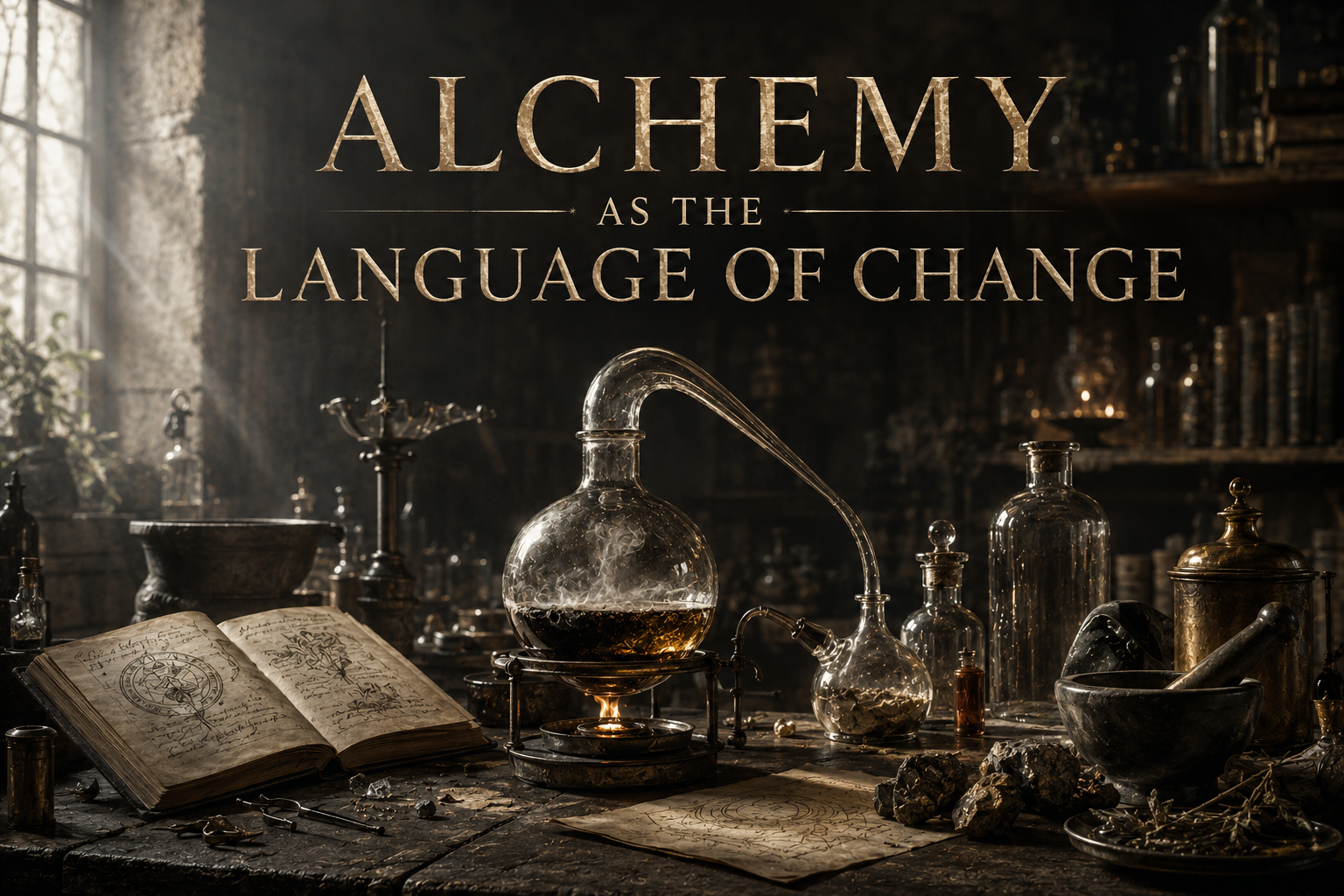
"The true work of alchemy is not merely to make gold, but to understand the laws by which anything becomes anything else."
Beyond the Myth of Gold
Mention the word alchemy, and most people immediately imagine an aging philosopher standing before a glowing furnace, carefully tending a crucible in the hope of transforming lead into gold. It is an image preserved in paintings, novels, films, and popular imagination for centuries. To many, alchemy represents little more than an abandoned science—a curious mixture of superstition and primitive chemistry that was eventually replaced by the precision of modern scientific thought.
Others have gone to the opposite extreme. In an attempt to rescue alchemy from accusations of pseudoscience, they insist that it was never truly about making physical gold at all. According to this interpretation, every furnace, every laboratory operation, every reference to metals or the Philosopher's Stone was merely symbolic language describing psychological or spiritual transformation.
History suggests that neither view is entirely correct.
Alchemy has always resisted simple definitions because it has always existed at the intersection of nature, philosophy, religion, medicine, craftsmanship, and metaphysics. Some alchemists sincerely pursued the transmutation of metals into physical gold. Others devoted themselves to preparing medicines, refining minerals, studying nature, or contemplating the hidden structure of creation. Many sought all of these simultaneously, believing that the laboratory, the human soul, and the cosmos were reflections of the same universal order.
To understand alchemy, therefore, we must begin by abandoning the false choice between literal gold and spiritual symbolism. Alchemy has always been larger than either. At its heart lies a far more profound question:
How does one thing become another?
That question is the true beginning of the Great Work.
The Historical Alchemist and the Birth of Chemistry
It would be historically dishonest to deny that many alchemists sought the manufacture of physical gold. Throughout antiquity, the Islamic Golden Age, medieval Europe, and the Renaissance, rulers financed laboratories, scholars composed elaborate treatises, and practitioners dedicated entire lifetimes to the pursuit of chrysopoeia—the making of gold.
To the modern mind this pursuit often appears irrational, yet within the worldview of traditional natural philosophy it possessed its own internal logic. Nature was understood as a living process rather than a collection of static objects. Metals were thought to develop within the womb of the earth much as living organisms matured over time. Gold represented the highest and most perfected expression of metallic existence. If nature herself slowly refined lesser metals toward perfection, then perhaps the skilled alchemist could cooperate with nature, accelerate her processes, and complete what time had only begun.
Whether such transmutation was ever achieved remains one of history's enduring mysteries. Yet success or failure is not the measure of alchemy's importance. The pursuit itself produced extraordinary advances in experimental practice. Alchemists refined distillation apparatus, developed laboratory glassware, improved furnaces, perfected techniques of calcination, sublimation, extraction, crystallization, fermentation, dissolution, coagulation, and countless other operations. They catalogued minerals, experimented with acids and solvents, investigated medicinal compounds, and established habits of observation that would eventually become central to scientific inquiry.
Modern chemistry did not appear in opposition to alchemy. It emerged from within it. The chemist inherited the laboratory that the alchemist built.
The Gold Beyond Gold
Yet if physical gold were the sole objective of alchemy, it is difficult to explain why so many alchemical texts devote equal attention to virtue, wisdom, divine illumination, purification, and the perfection of the human being.
The answer lies in understanding what gold represented.
Gold fascinated the ancient world because it seemed almost incorruptible. It resisted rust, retained its brilliance, endured the passage of time, and reflected light with extraordinary beauty. Nature herself appeared to have crowned it as the perfected expression of the metallic kingdom. It was therefore more than a valuable commodity. It became a symbol of permanence amid change, order amid chaos, and perfection emerging from imperfection.
For many alchemists, the making of gold was not abandoned in favor of symbolism; rather, physical and philosophical gold became inseparable. If nature could produce perfect metals through hidden processes, then perhaps those same processes governed the perfection of every other aspect of existence. The refinement of ore became an image of the refinement of character. The purification of metals mirrored the purification of perception. The perfection of matter reflected the perfection of the soul.
The real treasure of alchemy, then, is not simply the possession of gold.
It is the possibility of becoming gold.
To become stable rather than reactive.
To become luminous rather than obscure.
To become incorruptible rather than fragmented.
To become whole.
The Alchemies: One Principle, Many Laboratories
One of the greatest misconceptions inherited from modern culture is the assumption that alchemy refers to a single historical tradition. In reality, history presents us with many alchemies, each expressing the same fundamental intuition through different methods, symbols, and goals.
Chinese alchemy sought harmony with the Dao through the refinement of Jing, Qi, and Shen, understanding transformation as both physiological and spiritual. Indian Rasashastra united metallurgy, medicine, yoga, and sacred philosophy into an integrated science of purification and vitality. Islamic alchemists expanded both philosophical and experimental approaches to matter while preserving much of the Greek intellectual inheritance. European Hermetic alchemy combined Egyptian symbolism, Platonic and Aristotelian philosophy, Neoplatonic metaphysics, Christian mysticism, astrology, medicine, metallurgy, and practical experimentation into one of history's most sophisticated traditions of natural philosophy.
Yet the alchemical impulse reaches even further.
Whenever human beings consciously participate in lawful transformation, they engage in an activity that is fundamentally alchemical. The physician restores health where illness has disrupted order. The farmer cooperates with the hidden intelligence of nature, guiding a seed toward harvest through patience, timing, and cultivation. The artist transforms invisible imagination into visible beauty. The educator slowly converts ignorance into understanding, while the philosopher labors to refine confusion into wisdom through disciplined inquiry. The mystic seeks to transform separation into communion with the Divine, and the theurgist works toward the restoration of the soul's participation in higher realities.
These are not identical disciplines, nor should they be confused with one another. Each possesses its own methods, materials, and aims. Yet all participate in the same underlying architecture of transformation. The substances differ. The laboratories differ. The operations differ. What remains constant is the universal law that potential may be cultivated into actuality through right relationship with the principles governing change.
Alchemy as the Language of Change
If there is one definition capable of uniting all these traditions, it is this:
Alchemy is the disciplined study of lawful transformation.
Its true subject is not merely metals, medicines, or mystical experience. Its true subject is becoming.
Everything in existence is already engaged in continual transformation. Mountains erode into valleys. Rivers carve stone into canyons. Stars forge new elements within their fiery interiors before scattering them across the cosmos. Forests convert sunlight into living tissue. Caterpillars become butterflies. Children mature into adults. Every moment of existence is marked by the continual passage from one state into another.
The Greek philosophers possessed a remarkable vocabulary for describing this process. Every reality begins with an Archē (ἀρχή), an originating principle or first cause. From this arises an Ousia (οὐσία), an essential nature that contains within itself Dynamis (δύναμις)—its latent capacities and unrealized possibilities. Under appropriate conditions these hidden potentials awaken into Energeia (ἐνέργεια), active operation, until they eventually stabilize as Morphē (μορφή), manifested form.
This sequence is visible everywhere in nature.
The oak already exists within the acorn—not physically, but as potential. The cathedral exists within the architect's imagination before the first stone is laid. The musician exists within the beginner long before mastery becomes visible. The possibility always precedes the manifestation.
Alchemy studies precisely this movement from hidden potential into visible reality. It is not merely concerned with what things are, but with how they become what they are.
The Great Work
This understanding explains why the ancient alchemists referred to their lifelong pursuit as the Magnum Opus—the Great Work.
The Great Work was never simply an accumulation of knowledge or the acquisition of wealth. It was participation in nature's own movement toward greater order, refinement, and completion.
Its famous maxim, Solve et Coagula—dissolve and coagulate—expresses a principle that extends far beyond the laboratory. Every meaningful transformation requires the loosening of old forms before new forms may emerge. The seed must surrender itself before becoming a tree. Ore must endure the furnace before becoming purified metal. The individual must relinquish old assumptions before wisdom can appear. Even civilizations periodically dissolve established structures before new cultural forms emerge.
The alchemical furnace therefore becomes more than a physical instrument. It becomes an image of every circumstance that refines, purifies, and matures what enters it. Difficulty itself becomes a kind of fire. Time becomes a silent alchemist. Experience becomes the crucible through which character is slowly transformed.
The language of Sulfur, Mercury, and Salt expresses the same insight. Sulfur represents identity and the inner fire of purpose. Mercury is the principle of movement, mediation, communication, and transformation itself. Salt provides stability, memory, and enduring form. Every authentic process of becoming requires all three. Without Sulfur there is no direction. Without Mercury nothing changes. Without Salt nothing remains.
The Universal Grammar of Becoming
Perhaps the greatest contribution of alchemy is not a particular laboratory technique or philosophical doctrine, but a way of seeing the world.
It teaches us that reality is not fundamentally composed of isolated objects but of living relationships in continual transformation. Everything participates in an ongoing process of refinement. Nature herself is engaged in an endless work of becoming, and humanity participates in that work whether consciously or unconsciously.
Modern science observes transformation through biology, chemistry, geology, cosmology, and physics. Philosophy explores it through metaphysics and ontology. Religion contemplates it through conversion, sanctification, and union with the Divine. Psychology investigates it through development, healing, and individuation.
Alchemy does not compete with these disciplines.
It provides a language capable of recognizing the common architecture beneath them all.
It reminds us that every transformation, regardless of scale, follows intelligible principles. Whether we are refining metals, preparing medicines, cultivating virtue, educating children, restoring ecosystems, or seeking spiritual illumination, we are participating in different expressions of the same universal process.
In this sense, there are not merely alchemical laboratories.
There are alchemical lives.
Conclusion: Becoming Gold
Perhaps the greatest misunderstanding surrounding alchemy is the belief that its treasure lies at the end of the journey. The deeper wisdom of the tradition suggests otherwise. The treasure is found within the process itself.
Gold was never simply a metal to be possessed. It was nature's enduring image of perfected becoming. Whether the ancient alchemists pursued literal transmutation, universal medicines, spiritual illumination, or all three together, they were ultimately asking the same question that continues to confront humanity today: How may what is incomplete become whole?
That question extends far beyond the walls of the laboratory. Every life presents its own lead to be refined, its own furnace to endure, its own hidden gold waiting to emerge. Every act of learning, every moment of healing, every work of beauty, every exercise of wisdom, and every genuine transformation participates in the same Great Work.
To study alchemy, then, is not merely to study an ancient art or the forgotten ancestor of chemistry. It is to learn the language through which change itself becomes intelligible. It is to recognize that the universe is not a static collection of finished things but a living architecture of continual becoming, where potential forever seeks fulfillment and hidden possibilities strive toward manifestation.
The ancient alchemists sought the Philosopher's Stone because they believed perfection was woven into the fabric of reality itself. Whether that perfection revealed itself in a purified metal, a healing medicine, an enlightened mind, or a transformed soul mattered less than the principle they uncovered.
The universe is always becoming.
Alchemy teaches us how to become with it.